
Manufacturers cannot afford fastening processes that limit production speed, consistency, or flexibility as assembly demands increase. Choosing the right screwdriving approach can influence everything from operator efficiency and cycle times to fastening accuracy and future automation capabilities. Comparing handheld and robotic screwdriving systems helps engineering teams determine how much automation their application needs. By understanding … Continued
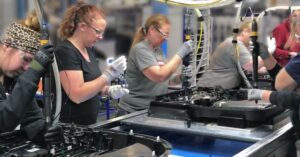
Manufacturers face constant pressure to increase output without sacrificing accuracy or product quality in large-scale warehouse and assembly facilities. Assembly teams need dependable equipment that keeps pace with modern production demands across automotive, electronics, medical, and industrial markets. For warehouse managers seeking better technology, it is important to understand automated fasteners feeding technology and how … Continued

Modern manufacturing leaves little room for inconsistency, especially as production demands continue to rise and quality expectations grow. Companies that rely on automated assembly need equipment that delivers speed, precision, and repeatable performance without slowing production. Understanding the key advantages of robotic fastening systems helps engineering teams identify opportunities to improve efficiency and build more … Continued
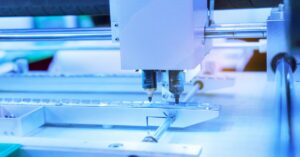
Manufacturing depends on precision at every stage of assembly. Even small inconsistencies in fastening can affect product quality, production speed, warranty claims, and customer satisfaction. Companies that prioritize consistent fastening performance often turn to automation to eliminate unnecessary variation from manual processes. Understanding how automatic screwdrivers improve accuracy helps manufacturers build more reliable products while … Continued
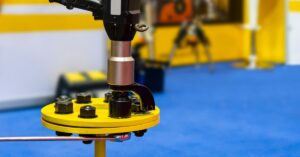
Manufacturers face constant pressure to increase output while controlling operating expenses. As labor costs continue to rise, companies compete for skilled workers and manage workforce shortages across many industries. Automation reduces labor costs in manufacturing by reducing manual tasks and increasing production capacity. Automation does far more than replace repetitive tasks. It creates streamlined workflows … Continued
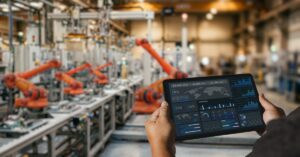
Fastener installation plays a critical role in modern manufacturing, where speed and consistency directly affect production outcomes. Companies across industries continue to adopt automation to improve assembly processes and meet increasing production demands. Automated fastening equipment eliminates many of the challenges associated with manual installation while supporting higher throughput. There are many benefits of automation … Continued
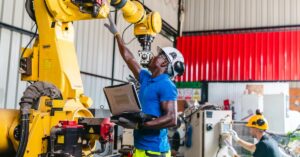
Manufacturers continue to face intense pressure to increase production without sacrificing quality. Robotic screwdriving improves assembly speed for teams, shortening cycle times and improving fastening consistency across every shift. Modern production facilities now rely on advanced motion control, precision torque management, and integrated tooling to maintain output targets. Companies that invest in robotic screwdriving technology … Continued
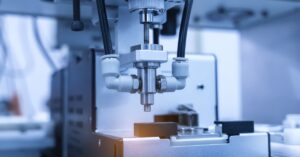
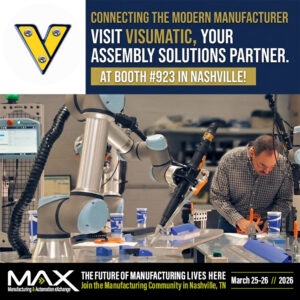
Experience the Future of Collaborative Assembly Take a test drive on a live cobot screwdriving workstation at the Music City Center in Nashville. Visumatic will be teaming up with our Tennessee sales team Assembly Solutions for the MAX Manufacturing & Automation eXchange show on March 25th – 26th 2026. Get a close up cobot experience … Continued
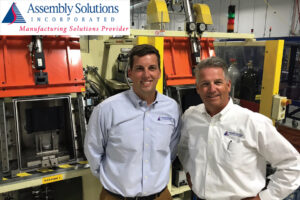
Visumatic Announces New Factory Representative in Tennessee Market Visumatic is please to advise that Assembly Solutions has assumed sales representative and customer support responsibilities for the state of Tennessee. The engineers at Assembly Solutions have been implementing factory automation for over 30 years. They reach every corner of Tennessee with quality solutions and decades of … Continued
How automation saved the license plate kit. Let’s be honest: repetitive tasks are the natural enemy of focus. For one license plate holder manufacturer, a “simple” bagging process was becoming a quality control nightmare. The Stakes: No Room for Error Each hardware kit required exactly four screws of two different types. If a customer received … Continued